Wednesday, May 21, 2014

Ferdinand Oyono’s Houseboy Pre-reading


1.     Look up the definitions of the following words and write them down in your journal.              


    • Mission civilisatrice
    • Alienation:
    • Negritude  
    • Cultural Colonisation 
    • Europeanisation
    • Assimilation


Copy and paste the poem below onto a word document. Read and annotate it using the insert comment. What is the object of satire in this poem and what is the persona’s attitude towards the ‘Vultures’? The poet is a negritudist just as Oyono. 

The Vultures By David Diop
In that time
When civilization struck with insults
When holy water struck domesticated brows
The vultures built in the shadow of their claws
The bloody monument of the tutelary era
In that time
Laughter gasped its last in the metallic hell of roads
And the monotonous rhythm of Paternosters
Covered the groans on plantations run for profit
O sour memory of extorted kisses
Promises mutilated by machine-gun blasts
Strange men who were not men
You knew all the books you did not know love
Or the hands that fertilize the womb of the earth
The roots of our hands deep as revolt
Despite your hymns of pride among boneyards
Villages laid waste and Africa dismembered
Hope lived in us like a citadel
And from the mines of Swaziland to the heavy sweat of  Europe’s factories
Spring will put on flesh under our steps of light
.

Friday, March 7, 2014

The Importance of Being Earnest Act 1

Read the first act of the play and respond to the following questions in complete grammatical sentences.
  1. The Importance of Being Earnest is called comedy of manners. What impressions do we get of the society in which the play is set? How is it presented?
  2. What is the literary purpose of Lane.
  3. How has the playwright used Dramatic Irony and Epigrammatic Wit? Give two examples of each.
  4. What makes the first act funny? Quote and comment. 
  5. To what extent do you agree that the female characters dominate the men?


Friday, May 4, 2012

Houseboy By Ferdinand Oyono


Why do you think that the novel is full obscenities? Ironically it is the priests, Father  Gilbert and Vandermayer who are described by Toundi to speak obscenities, in their sermons and also dreams. Why is Toundi's Diary full of obscenities and sexual innuendo? Post your thoughts in no less than 100 words, with reference to at least one quotation from the novel.

Thursday, October 27, 2011

Hamlet Act 3

Scene 1
  1. Does Hamlet Love Ophelia? Explain your answer.
  2. Comment on Claudius aside, what does it reveal about his character? How would have the audience responded to the aside? 49-54
  3. What evidence is there to suggest that Claudius doubts Hamlets insanity? 160-183
  4. How does Claudius intend to deal with Hamlet?
  5. What do you think about the way Ophelia and Gertrude are being used? 35-48, 170-181

Scene 2
  1. Why does the 'dumb show' preceding the play bring no comment from Claudius?
  2. Comment on lines 240-245
  3. What is the function of the conversation between Hamlet and his childhood friends?
  4. Explain Hamlets attitude towards his mother as revealed in the soliloquy that ends the scene.
Scene 3

  1. In 3.3 36-98, Claudius tries to pray, and Hamlet has the opportunity to kill him.
  2. What motivates Claudius to pray? Do you think he is sincere? Explain. What does this scene reveal about Claudius? Give specific phrases and lines to support your ideas.
  3. Why is Hamlet unable to kill Claudius? What does this reveal about his character? Give evidence to support your response.
  4. What do you make of the fact that this is the only scene in which Claudius and Hamlet appear on stage alone? Why do you think Shakespeare does not have any other characters on stage at this moment in the play?
 

    Sunday, October 9, 2011

    Hamlet and Allusion

    1. Define Allusion.
    2. Allusion in the play
    3. In Hamlet, Aeneas’s tale Aeneas’ tale alludes to Hamlet’s life. What other function does the play within a play play? (no pun intended) Post your responses on the blog. When you post, make sure you read what is there in the comment stream. Try to write something new or give a new perspective to the ideas under discussion.
    4. Excellent examples of other literary techniques such as Anaphora and Apostrophe. A must see.
    5. No Fear Shakespeare website: http://nfs.sparknotes.com/hamlet/page_2.html

    Thursday, September 29, 2011

    Hamlet by William Shakespeare


    IOC OUTLINE: 
    INTRODUCTION: BRIEFLY, What is important about this passage? (Why was it chosen?) What key ideas does it capture (about characters, relationships, themes, etc.)? What is the context of the passage (where does it fit in the play?)

    BODY (PART 1): THE PASSAGE: Discuss what is important about this passage. Consider the following:
    a)      What does it reveal about character(s)?
    b)      What does it reveal about theme(s)?
    c)      Discuss the literature devices in the passage (Metaphors, allusions, personification, imagery, etc.)

    BODY (PART 2): THE CONTEXT: Discuss how your passage fits into the overall story. Consider the following:
    a)      How is it crucial to the flow of the plot?
    b)      “Character development.” How did the character(s) get to this point? What does the passage confirm, refute, etc. what you’ve witnessed so far with these characters?
    c)      Larger themes (big underlying ideas) of the story. For example, does it connect with the theme of jealousy? Revenge? Deception? Delusion? Love?
    d)      Language: Are there metaphors, symbols or images in your passage that “echo” earlier ones?

    CONCLUSION: Possibilities: What does it all add up to? ESSENTIALLY, why out of all the passages in the act did you think this one was picked? Perhaps choose a final quotation from the passage and explain how it sums up what's most important about the passage.

    What Literary techniques do I look for in my excerpt?
    • Different types of imagery: e.g. disease/heaven and earth/references to death
    • Tragic elements
    • Verse, free verse, prose
    • Foreshadowing
    • Use of double entendres/puns
    • Use of asides/soliloquies
    • Symbolism
    • Metaphors/similes /personification
    • Sounds/alliteration/ assonance/sibilance
    • Allusions, biblical or mythology
    • Use of minor characters
    • Contrasts
    • Entrances/exits
    • Characterization/relationship between characters/changes in character
    • Setting


    Read more: http://www.brighthub.com/education/k-12/articles/27057.aspx#ixzz1bbApvCjV

    Act 1 Scene Two

    This man Claudius. Sorry, King Claudius.

    Consider Claudius' monologue.Do you agree with King his reasoning? What do you think about his actions as revealed in this scene?

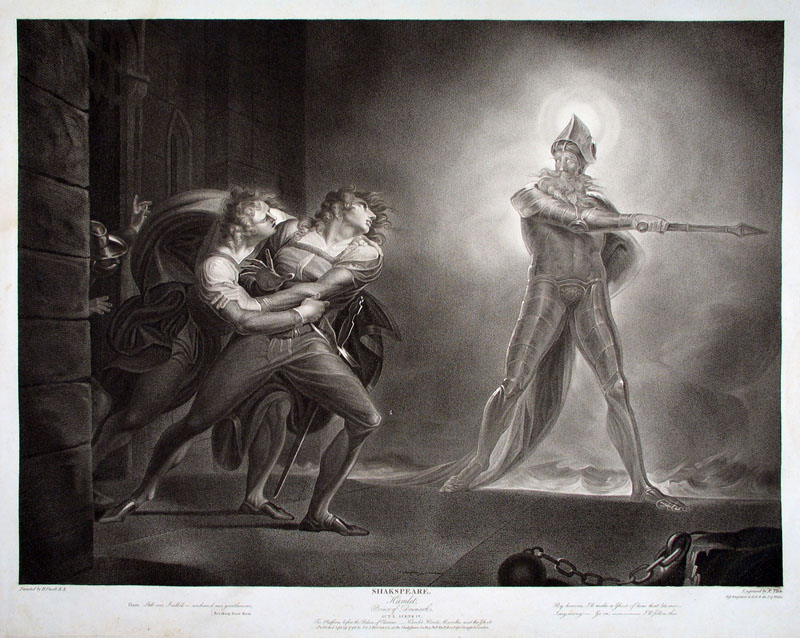
    Act1 scene 1.
    1. Define Setting.
    2. Consider the when and where (illustrate from the scene). What atmosphere is created by the setting of this scene.You can find a modern text version here
    3. What questions do you have at the end of this scene? Predict what will happen in the next scene. Post your questions and predictions as comments.